Showing posts with label PLC. Show all posts

Sunday, 28 April 2013

Remixing 1:1

A week ago I didn't even know what they were called. I had seen one or two before, but I had no idea how big they had become. In fact, many people now consider remixing, or taking an existing work and adding your own take on it, an art form. As I sat there last week discussing the power of a "remix" at the Beyond Laptops Conference at Yokohama International School (YIS), I thought, yeah, they're cool, but how can I use them in the classroom?  Little did I know that my own students had been making one for me for the past month.  

On Wednesday morning, our team of 100 students filed into the grouproom for a "surprise" group homebase.  It was my birthday, so I suspected that something was up.  Ryan and AJ got up and stood in front of the group and said,  "We made this video for Mr. Riley's birthday. We hope you enjoy it."  


I was floored.  It's amazing that they were able to gather all those students and teachers, record the exact phrases they needed, and use nothing but a smartphone and a flip camera.  But that's not the point. The point is these kids spent all that time, energy, and effort to create something totally unique for me.   And while I'm still trying to figure out why those boys picked "Back in Black" by AC/DC, I was truly touched because it was a gift from the heart. 

It got me thinking about what a 1:1 laptop program is really about. We're in the midst of implementing one right now in the Middle School.  The 7th grade roll out is complete, and there's much to celebrate.  Our tech team designed a thoughtful and thorough "boot camp," and core teachers led subject-related modules with their students.  Their collective work and experience will help guide the rest of the school's roll out in August.  


In teams and in classes, it seems that many of our conversations are about the device.  At this point, they should be.  After all, when there are hundreds of laptops around the school, we all need to have common expectations.  Not only that, as teachers, we need to think about how we can use them in the classroom.  


When we get caught up focusing on the device though, we forget that a 1:1 program has to do with so much more.  With my birthday video, for example, it wasn't about Ryan and AJ's phone or camera features.  It was about how they used them to connect with others and tell a story.  It was about how they used them to connect with me.  In the end, "1:1" isn't between an individual and a device, "1:1" is between one individual and another individual.  And when they connect, ideas are shared, and learning grows.

Just by chance, on the very same day, I "met" Jabiz Raisdana, a colleague at UWC via Twitter.  Here's his take on technology and 1:1 that he posted on his must-read blog, Intrepid Teacher:

Technology shouldn’t be a gimmicky lure we use to “engage” kids.  We use it when we can, when we must, when it makes sense. Otherwise we talk about writing. We write. We explore. Engagement is about passion and love for what we do. It is about getting on the floor and talking to kids about their ideas and giving them immediate feedback. 1-1 means that we try to spend time with each student discussing their work, not speaking at a class about what they all should be doing. No amount of technology will motivate kids, if the pedagogy and the content and the teachers love for the material is not there.

Ryan, AJ, and their friends were motivated to create their video not because of technology.  It was because of story, a way to tell it, and an audience to share it with.  With the remixed 1:1, we'll have many more opportunities to communicate through a wider range of formats with a much greater audience.  Here's how my students and I were motivated to communicate this week through 1:1:
Confessions of a Nincomtweet

  • My students wrote introductory "cover letters" to their 21st century pen pals at YIS, inviting them to read their blogs.  They have since exchanged back and forth emails and commented on each others' blogs.
  • I tweeted out a picture of them blogging along with a thanks to the tech coaches for connecting our classes. Hours later, I heard back from all of the coaches thanking us instead.
  • Grade 8 teachers responded to a Google survey providing critical questions and inspiring ideas for our upcoming labsites.
  • I continued building my virtual PLC on Twitter by following colleagues near and far.
  • Grade 6 teachers started crafting a sample persuasive essay on why bottled water is all washed up on a shared Google doc.
Sure, with each of these interactions, there are devices involved and software to learn.  As we learn them, I'm sure we'll stumble along the way, or we may even end up learning them from our students.   That's okay, because when we do, we'll be connecting with others, sharing ideas, and learning every step of the way.

Sunday, 3 February 2013

It's All About the Process

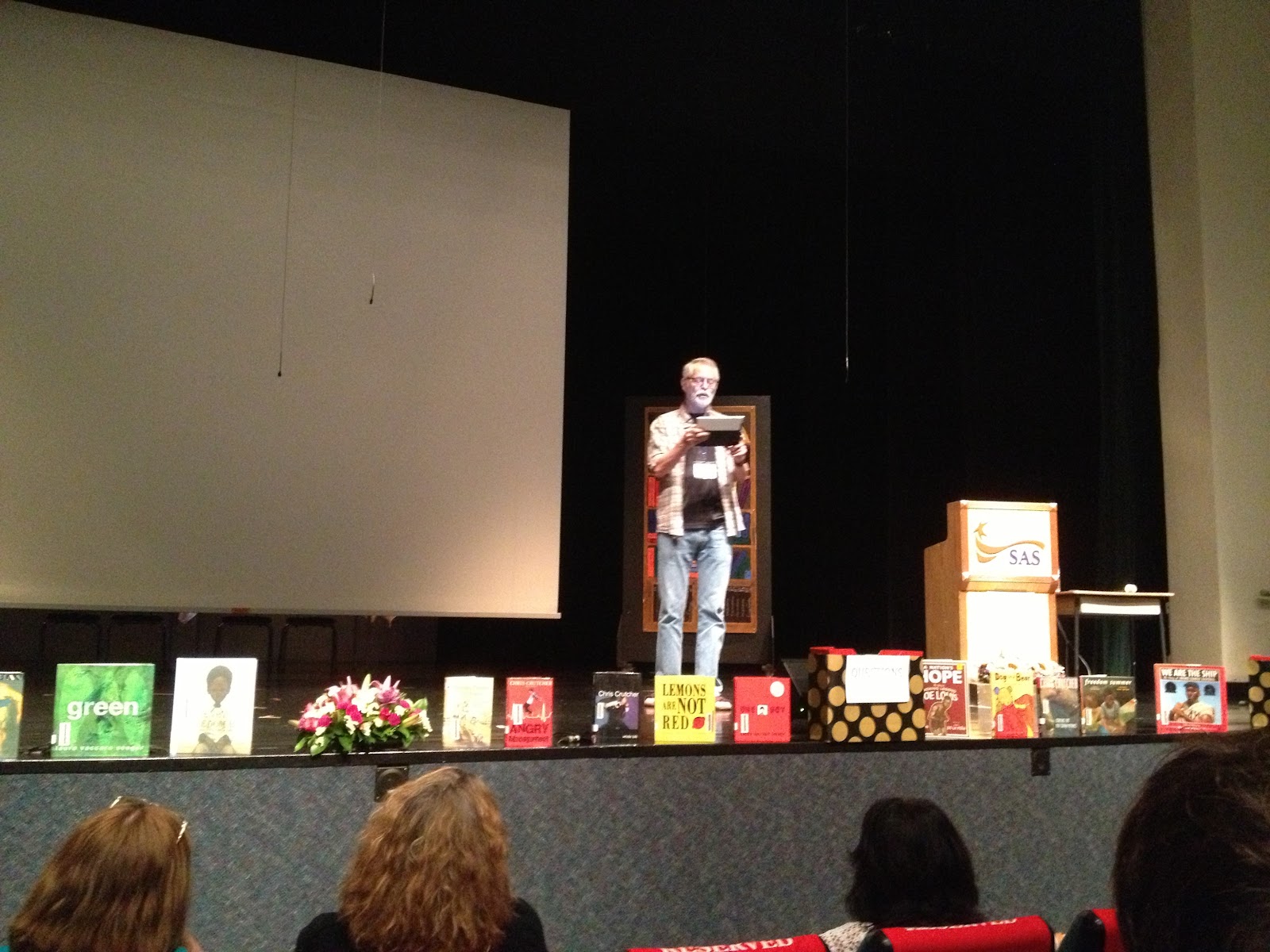
Two weeks ago, I made a bold proclamation that 2013 should be the "Year of Revision."  In an uncannily ironic move, I'd like to revise that.  Now, before you throw your hands in the air, hear me out.  You see, I just spent a day and a half with four amazing award-winning authors and illustrators at SAS's Children's Literature Conference, and one of my many take-aways from the experience is that it's not only about revision, it's about the entire process.

With Debbie Wiles and her heart-warming tales of small town southern charm, Chris Crutcher and his edgy teen characters who face impossible odds, Kadir Nelson and his awe-inspiring portraits of people whom history can't forget, and Laura Vacarro Seeger and her bold colors and simple words that aim at the heart of an idea in such complex ways, the presenters couldn't have seemed more diverse.  Yet throughout the course of their sessions, as they each shared their experiences and processes, I saw well beyond their final products to something greater.


What was common in all of their work was the process.   When they work, they trust their voice, they listen to it, and they “bring total intimacy to it.”  They draw on their experiences as far back as childhood to inform it.  They use it to "link their mind to their heart and let it come out with actions."  And while every idea may not work out in the end, they are brave enough to put pencil to paper and try it out.  In short, they trust in the process.

So what does this mean for us as teachers?  I know that we (and our students) may never be Coretta Scott King nor Caldecott winners, and I know that we have certain obligations that these professionals don’t.  But I also know that we are committed to developing the best readers and writers we can.  With that in mind, I wonder about the following:


  • How do we honor the process vs. the final product?
  • How do we invite our students (and ourselves) to “try it out?”  Do they see the value in it?
  • Is voice something we teach or something we foster?
  • How do the units of study help and/or hinder our writers in developing voice?
  • How does our pacing of units affect our writers?
  • Isn't this the same process we use when we teach?

And while I don’t pretend to know the answers to these questions, I do know that by asking them in our PLCs and setting possible plans with colleagues, we’ll continue to learn and grow.  After all, there’s no way we can know the answers without going through a process.

Sunday, 2 December 2012

The Coaches Clinic


"Now your bottom hand is the lower jaw of the shark," Coach Oscar yelled to the players as he crouched down and thrust out his left arm.  "The other hand is the upper jaw of the shark.  And when the ball comes towards you, the shark gets hungry."  A player threw a grounder towards Coach Oscar, and he clamped his hands together to grab the ball.  "Is that clear?" Coach Oscar asked.

I looked down the row of players and saw my daughter, Isabelle, and the others nodding.  In minutes, they were all crouching low and snatching up the grounders, and in that moment, the players attending the 2nd-4th Grade Baseball Clinic had become a sea of hungry sharks.

With each skill, Coach Oscar broke it down into a series of moves.   He used metaphors and connections like a hungry shark so that the kids could grasp the concepts more effectively.  He related everything he was doing to what the major league players do, and most importantly, he gave the students lots of time to practice.  

One thing was clear.  The kids were getting it.  In a matter of minutes, they were throwing the ball infinitely better than they had at the beginning.  The key to their success was that Coach Oscar was enabling them to learn by doing.  After showing them (I do), he walked around as they practiced and gave further instructions if needed (We do).  Soon enough, they were all doing it on their own (You do).

As I was watching Isabelle and the other players learn basic skills in throwing, fielding and batting in their Baseball Clinic, I couldn't help but think, where was this coach when I was a kid.  After all these years, I was finally learning how to throw a baseball.  I was also thinking that what I was watching was a form of a Reading and Writing Workshop.  

The idea of the workshop as a clinic isn't a new one.  In fact, just the other week, Sara Holbrook and Michael Salinger, our recent resident poets in 8th grade, referred to their workshops in the classroom as clinics, and now I was realizing exactly why they use that term.

The metaphor of a clinic shouldn't just stop there though.  If our time in the classroom is like a Reading and Writing Clinic for our students, our PLC work together is the Coaches Clinic.  This is when we share our own moves as professionals.  It gives us time to map out essential skills of a unit and plan how we can best assess them.  It gives us a chance to "watch the tapes" of our players after the fact and see what worked and what didn't. And it gives us the opportunity

Over Thanksgiving, a group of 25 SAS teachers and I headed to Siem Reap, Cambodia, to conduct our own Coaches' Clinics with our Cambodian counterparts from the Caring for Cambodia schools.  The focus for this year's teacher training trip was science (thank goodness for Jemma H. as I was literally and figuratively out of my element).  For two days, we met teams of teachers to discuss the content, try out some experiments, and explore effective teaching strategies. 

We used the same methods for effective teaching  (I do/We do/You do) that Coach Oscar used in his clinic, and by the third day, the teachers were ready to try the lessons out in their classrooms.  

As we traveled to the five schools on that day, we were amazed at how quickly the teachers had picked up some key concepts such as having students work in groups and letting them do the experiment.  And instead of the teachers always giving the answers, they asked questions and elicited responses from the students.  All this with classes of 50 plus students.

When we arrived at the last school, we noticed right away that the teacher had taken our experiment of mixing water with different solids and liquids and made it better.  Instead of having each group mix all of the substances with water, she had the groups do one each and then compare results across the class.  What did was exactly what we do in our work.  We learn from each other by taking good practices and techniques and making them in our own in the classroom.  

As I get ready for another week in the classroom and look forward to another Coaches Clinic with my PLC, I'm reminded of the following essentials:
  • Teach effectively by breaking the skills down into manageable steps, connecting new learning to prior knowledge or frameworks (the hungry shark), and aIlowing for lots of practice (I do/You do/We do) and timely feedback.
  • View PLCs as a time for me to learn.  I can pick up tips and strategies from my colleagues, and I can gain greater insight from our collective experiences.
  • Know my students as best as I can so that I can help them individually and ensure successful lessons for the entire class as a whole.