Showing posts with label authors. Show all posts

Sunday, 20 January 2013

2013: The Year of Revision

Some might say that I was going a little overboard as I sat down for the sixth time to revise the Kadir Nelson bio I was writing for the upcoming Children's Literature Conference.  I know, it's only three paragraphs.  Not only that, it'll appear only for a short time, tucked in to the inner pages of the Conference program.  But I also know this.  Every time I sit down to revise a piece of my writing, it gets better. Every time.


Coincidentally, Brian Combes just sent this video out reminding us of the power of word choice.  It also speaks to the power of revision.  If the first draft of that man's sign was never rethought, reimagined, or reworked, it would never have left an impact on those who passed by. It's the same with our own writing.  And our students'.

I'll admit it, I don't emphasize the importance of revision enough with my students.  Most of my lessons are on generating ideas and introducing new craft techniques.  When it comes time to revise, sure I give them some time, but I don't give them new tools on how to do it.  Instead, I expect them to know how, or I allow them to have their partners revise their piece for them.  Not only are the not learning the way in which writers revise, some of them think revision requires another person to look at their piece and tell them what to do next.  That's why one of my New Year's Resolutions is to make 2013 The Year of Revision.

At its etymological core, "revision" means "the act of seeing something again."  When we do, we often see things in a new light.  It's like when we notice new details in a work of art or a background rift in a piece of music when we listen to it over and over.  Writers know this about revision, and they trust in its process to make their work shine brighter.  In fact, they spend the bulk of their time revising.  Remember two years ago when Linda Sue Park told us she revised When My Name Was Keoko 37 times?  

Simply put, revision matters.  I know I'm not the first to point this out, and I certainly won't be the last.  In his most recent book, Write Like This, Kelly Gallagher dedicates an entire chapter to revision.  In it, he says that most students stop at the "Down Draft," the first draft when they get their ideas down.  As teachers, we must place greater importance on the "Up Draft" when they begin to fix it up.  That's where good writing happens.  Unfortunately, it can be an uphill battle as we all face the "one-and-done" mentality that most of students have.


Recently, some of us in Grade 6 took one of Gallagher's practical ideas for teaching revision and ran with it.  By using a radar as a metaphor (and mnemonic device), we taught one revision strategy.  Like a radar that identifies "blips on the screen," a writer identifies words, phrases, sentences, or even whole paragraphs that need attention when revising.  Once she does, she can use the RADaR to improve it by:


RAD andR
Replace...

  • words that are not specific.
  • words that are overused.
  • sentences that are unclear.
Add...

  • new info.
  • descriptive adjectives and adverbs.
  • literary devices/ figurative language.
Delete...

  • unrelated ideas.
  • unwanted repetition.
  • unnecessary details.
Reorder...

  • to make better sense or to flow better.
  • so details support main ideas.

An additional key in teaching revision goes beyond just teaching the strategy though.  As Gallagher highlights, teachers need to think aloud during the revision process by taking a piece of their own writing and revising it in real time.  That way, students can see the possibilities as well as the challenges.

So, as we begin the new year, I hope you stand with me in making 2013 The Year of Revision.  I hope that my revisions on the Kadir Nelson bio pay off and that you enjoy reading them in the Children's Literature Conference program in two weeks' time.  And I hope that you got something out of this post (even though I only gave it five revisions).


Sunday, 14 October 2012

The Other Teacher in the Room

In one of my recent posts, I mentioned that there are other teachers in the room, and we can use technology to invite them to participate in ways that seemed unimaginable even just a couple of years back.  Of course, these teachers are the students, and they certainly have a  lot to add to every discussion and activity. This week I was reminded of something that I know all too well but forget far too often.  There's yet another teacher in the room, the author.  

Through read alouds, shared texts and independent reading, we sit down with these master storytellers and revel in their work.  We look closely at the choices they make, use them as inspiration, and even try to emulate them in our own writing.  The thing is, with technology these days, the learning does not have to stop with reading their books.  There are countless ways to connect with them.


Email or Skype the Author


Megan, a student of mine, rushed into the classroom during break earlier this week.  "She wrote back!" she beamed.  She was none other than Jennifer Armstrong, author of Shipwreck at the Bottom of the World.  

Just a few days before, Megan handed in her letter to Armstrong as a reading response for my class.  She wasn't too optimistic that she would hear back from her, but she was glad she tried.  She came up with the idea of writing to Armstrong when I showed the class my letter to Goodreads about possible interview questions for Lois Lowry on her new book, Son.  Asked how she got the author's address, Megan answered,  "Simple.  It's online."

But then Armstrong's reply came, and it made all the difference in the world to Megan. In it, Armstrong elaborated on how she came up with the topic and how the publication of her finished product was pure serendipity as it coincided with a nationwide exhibit on Shackleton's trip.  Check out Megan's response to Armstrong's letter:


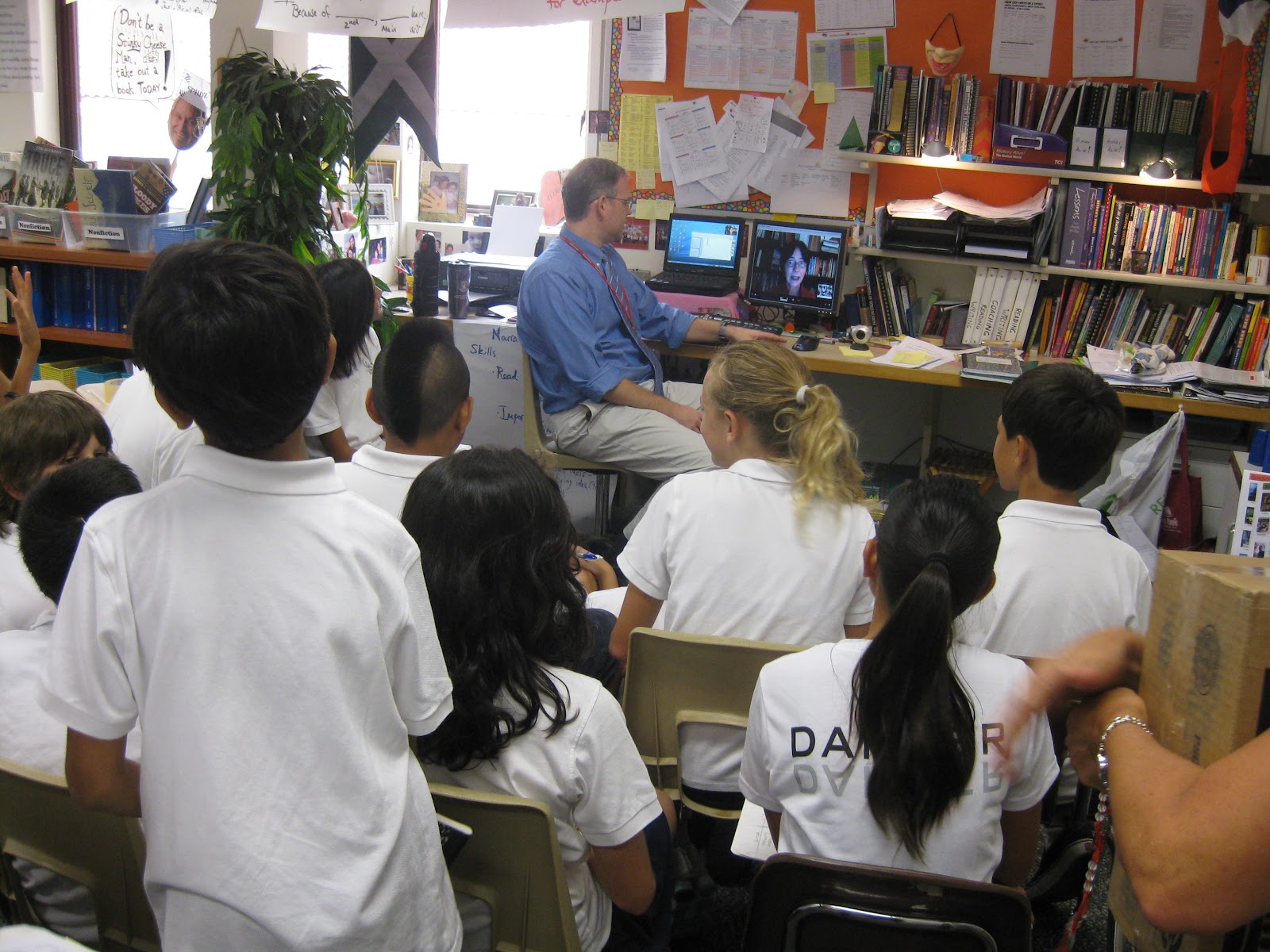
On lucky occasions, email may lead to something else.  Last year, I was fortunate enough to collaborate with Katherine Schlick Noe, author of Something to Hold. In a culminating activity, my classes skyped her and asked her questions about her book and her writing process.  During the interview, they showed her their extension project work as well.  While some authors may not be as willing to communicate with their readers, you'll never know if you don't ask.


Check Out Blogs and Websites


Nowadays, authors are asked to maintain an online presence.  Whether they're blogging about the books they read and schools they visit like Linda Sue Park or writing some brief photo essays like Debbi Wiles, authors are showing their writing in new ways.  

What better way to get to know authors before reading a book club book or read aloud novel than checking out their websites.  They may even have some hidden treasures there.

In this week's Mock Caldecott meeting, Nancy reminded us of this when we talked about Laura Vaccaro Seeger's amazing book Green.

On her website's link for educators/kids, Seeger showed images of her sketchbook and explained how the ideas for this book grew from the very first seeds.  After reading it, I appreciated the book on a whole new level.


Watch Book Trailers and Related Videos

Another exciting possibility is the book trailer,  Based on movie trailers, these short videos are the book talks of the 21st Century.  And with a potent mix of sound, images and video clips, it's no wonder they are a hit with readers of all ages.  It's not surprising that teachers and students are getting into the mix as well by creating their own book trailers.  Check out these Book Trailers of some popular titles:


But good videos about books aren't limited solely to book trailers.  The other day I was visiting Nancy and Brian M.'s class, and they had just shown this video about Iqbal as a final point of reflection after having read the book aloud in class.  


Log on to Goodreads


Many of our Grade 7 and Grade 8 classes are logging on to goodreads.com.  I'm starting to understand why.  After rating twenty books or so, users get recommendations and notifications of new releases that match their profiles.  Not only that, goodreads sends out invitations to participate in author interviews and live chats.

In fact, if you've read The Future of Us or Wonder, there's a live chat with the authors coming up on October 23rd.  Click here to find out more.


These ideas may just be the tip of the iceberg, but my point is this:  there is no doubt that learning about an author can go well beyond that page or two in the back of the book.  As readers, we need to check out what else is out there.  When we do, that other teacher in the room may quite literally come to life before our very eyes.


Images from:  goodreads.com;  buttontrapper.com