Showing posts with label blogs. Show all posts

Sunday, 28 April 2013

Remixing 1:1

A week ago I didn't even know what they were called. I had seen one or two before, but I had no idea how big they had become. In fact, many people now consider remixing, or taking an existing work and adding your own take on it, an art form. As I sat there last week discussing the power of a "remix" at the Beyond Laptops Conference at Yokohama International School (YIS), I thought, yeah, they're cool, but how can I use them in the classroom?  Little did I know that my own students had been making one for me for the past month.  

On Wednesday morning, our team of 100 students filed into the grouproom for a "surprise" group homebase.  It was my birthday, so I suspected that something was up.  Ryan and AJ got up and stood in front of the group and said,  "We made this video for Mr. Riley's birthday. We hope you enjoy it."  


I was floored.  It's amazing that they were able to gather all those students and teachers, record the exact phrases they needed, and use nothing but a smartphone and a flip camera.  But that's not the point. The point is these kids spent all that time, energy, and effort to create something totally unique for me.   And while I'm still trying to figure out why those boys picked "Back in Black" by AC/DC, I was truly touched because it was a gift from the heart. 

It got me thinking about what a 1:1 laptop program is really about. We're in the midst of implementing one right now in the Middle School.  The 7th grade roll out is complete, and there's much to celebrate.  Our tech team designed a thoughtful and thorough "boot camp," and core teachers led subject-related modules with their students.  Their collective work and experience will help guide the rest of the school's roll out in August.  


In teams and in classes, it seems that many of our conversations are about the device.  At this point, they should be.  After all, when there are hundreds of laptops around the school, we all need to have common expectations.  Not only that, as teachers, we need to think about how we can use them in the classroom.  


When we get caught up focusing on the device though, we forget that a 1:1 program has to do with so much more.  With my birthday video, for example, it wasn't about Ryan and AJ's phone or camera features.  It was about how they used them to connect with others and tell a story.  It was about how they used them to connect with me.  In the end, "1:1" isn't between an individual and a device, "1:1" is between one individual and another individual.  And when they connect, ideas are shared, and learning grows.

Just by chance, on the very same day, I "met" Jabiz Raisdana, a colleague at UWC via Twitter.  Here's his take on technology and 1:1 that he posted on his must-read blog, Intrepid Teacher:

Technology shouldn’t be a gimmicky lure we use to “engage” kids.  We use it when we can, when we must, when it makes sense. Otherwise we talk about writing. We write. We explore. Engagement is about passion and love for what we do. It is about getting on the floor and talking to kids about their ideas and giving them immediate feedback. 1-1 means that we try to spend time with each student discussing their work, not speaking at a class about what they all should be doing. No amount of technology will motivate kids, if the pedagogy and the content and the teachers love for the material is not there.

Ryan, AJ, and their friends were motivated to create their video not because of technology.  It was because of story, a way to tell it, and an audience to share it with.  With the remixed 1:1, we'll have many more opportunities to communicate through a wider range of formats with a much greater audience.  Here's how my students and I were motivated to communicate this week through 1:1:
Confessions of a Nincomtweet

  • My students wrote introductory "cover letters" to their 21st century pen pals at YIS, inviting them to read their blogs.  They have since exchanged back and forth emails and commented on each others' blogs.
  • I tweeted out a picture of them blogging along with a thanks to the tech coaches for connecting our classes. Hours later, I heard back from all of the coaches thanking us instead.
  • Grade 8 teachers responded to a Google survey providing critical questions and inspiring ideas for our upcoming labsites.
  • I continued building my virtual PLC on Twitter by following colleagues near and far.
  • Grade 6 teachers started crafting a sample persuasive essay on why bottled water is all washed up on a shared Google doc.
Sure, with each of these interactions, there are devices involved and software to learn.  As we learn them, I'm sure we'll stumble along the way, or we may even end up learning them from our students.   That's okay, because when we do, we'll be connecting with others, sharing ideas, and learning every step of the way.


Sunday, 17 February 2013

Teaching 21st Century "Genres"

"Just as we would rarely [teach] a unit or a lesson in any subject 
without incorporating some reading, we should also rarely do anything in school 
without incorporating technology—used powerfully and not trivially. 
If we do not do this, our kids will not be getting what they need from our education.”


Blogs, tweets, text messages, status updates, Skype, Youtube, let's face it, people today are communicating in ways that were unimaginable only a few years ago. In fact, we'd be hard-pressed to find another time in human history when there was such an explosion of new communication tools, and it doesn't seem like it will let up any time soon.

While many experts refer to these as Web 2.0 or 21st century "tools," I like to think of them as 21st century "genres." Like the more traditional genres we know and love, these genres have specific features, characteristics and rules that authors know and use to make their ideas stand out. As teachers of reading and writing, we must consider teaching to these genres in our classrooms. After all, our students are far more likely to become avid authors in these genres than they are in the traditional ones. 

With a quick Google search, you can find tons of "tools" out there that can help jazz up an idea or message (just check out the magic 8 ball message or the "cool links" geogreeting and the ninja message below), but these aren't really genres. According to Merriam-Webster, a genre is a category of artistic, musical, or literary composition characterized by a particular style, form, or content.


One genre that some of us are currently using with our students is the blog. With mini-lessons on commenting, adding videos and images, labeling posts, and ensuring that everything we publish passes through the POST Filter (Purpose, Offer new insight, Skillful writing, and The Core Values), we've added it to our Personal Essay unit in Grade 6.

With that model of teaching into a 21st century genre in mind, some of us recently sought out other genres that require students to apply effective conventions and communication techniques that emulate real-world 21st century genres. We didn't need to look far as our counterparts in the Intermediate School have used Fakebook, and we came across others like fake Twitter feeds, iPhone chats and Google stories. They were just what we were looking for as we asked our students to respond to their Greek mythology reading.

                                                     *              *              *              *              *


Many of us use Facebook to connect with friends and family both near and far and share what's going on in our lives. And while students need to wait to create their own accounts, they can become familiar with the genre through Fakebook, a site where students can create a fake profile, friend list and string of status updates.

When we asked our students to pick a Greek mythology character and retell the myth from his/her point of view, we were impressed with what they came up with. Check out Bryanna E.'s sample on Pandora (click View Full Screen to remove the ads):


View Fullscreen | Create your own

                                                     *              *              *              *              *


Twitter is another genre that has taken the world by storm. I have to admit that I'm more of a novice with this one, but every loyal user I know swears by it. Through Twitter, users are able to follow others (i.e. experts in their field) as they tweet out messages and announcements in 140 characters or less. There are also specific features with user names and hashtags that help users manage their tweets.

While the fake Twitter feed seemed to be a bit trickier than Fakebook, it worked for Claire R.:


                                                     *              *              *              *              *


If you don't think students need to learn Twitter quite yet, how about iPhone chats? Chances are if they don't own an iPhone, they may know someone who does.

By focusing on how to write succinct messages with the abbreviated text language, they learn how this genre is unique from the rest (and how these conventions don't work in other forms of communication).

Here is AJ K's chat from Perseus to Persephone:


                                                     *              *              *              *              *

Finally, with Google Story Builder, students can capture a group of characters' collaboration on a Google Doc.  Our students found this option to be the trickiest, but it is also one that leaves a lasting impression.  Here's my sample: 


I'm sure we'll come across more genres like this in the future, but for now, I know one thing is for sure: when our students sat down to try them out, they were engaging with the content like never before. Not only did they enjoy taking on the voices of the mythical characters, they knew the skills they were practicing would be useful to them. In short, the learning was relevant, purposeful, and, according to them, "fun."

So, consider trying one of these out. Add it to the possible repertoire of reader responses. Alternatively, if you know of another genre/site, leave a comment. One word of caution though. As with any technological project, be prepared for some unexpected hiccups along the way. Whatever you do, try it out yourself beforehand, and be sure to have a tech guru on speed dial. Thanks, Heather!


Common Craft Explanations
Web Tools 4U2 Use
Cool Tools for Schools
The Daring Librarian


Images from:
  • http://www.thedaringlibrarian.com/
  • http://www.abcnews.go.com
  • http://www.pressplay.co.ke/
  • http://www.tusconsentinel.com
  • http://www.geogreeting.com/
  • http://www.fodey.com/generators/animated/ninjatext.asp

Sunday, 14 October 2012

The Other Teacher in the Room

In one of my recent posts, I mentioned that there are other teachers in the room, and we can use technology to invite them to participate in ways that seemed unimaginable even just a couple of years back.  Of course, these teachers are the students, and they certainly have a  lot to add to every discussion and activity. This week I was reminded of something that I know all too well but forget far too often.  There's yet another teacher in the room, the author.  

Through read alouds, shared texts and independent reading, we sit down with these master storytellers and revel in their work.  We look closely at the choices they make, use them as inspiration, and even try to emulate them in our own writing.  The thing is, with technology these days, the learning does not have to stop with reading their books.  There are countless ways to connect with them.


Email or Skype the Author


Megan, a student of mine, rushed into the classroom during break earlier this week.  "She wrote back!" she beamed.  She was none other than Jennifer Armstrong, author of Shipwreck at the Bottom of the World.  

Just a few days before, Megan handed in her letter to Armstrong as a reading response for my class.  She wasn't too optimistic that she would hear back from her, but she was glad she tried.  She came up with the idea of writing to Armstrong when I showed the class my letter to Goodreads about possible interview questions for Lois Lowry on her new book, Son.  Asked how she got the author's address, Megan answered,  "Simple.  It's online."

But then Armstrong's reply came, and it made all the difference in the world to Megan. In it, Armstrong elaborated on how she came up with the topic and how the publication of her finished product was pure serendipity as it coincided with a nationwide exhibit on Shackleton's trip.  Check out Megan's response to Armstrong's letter:


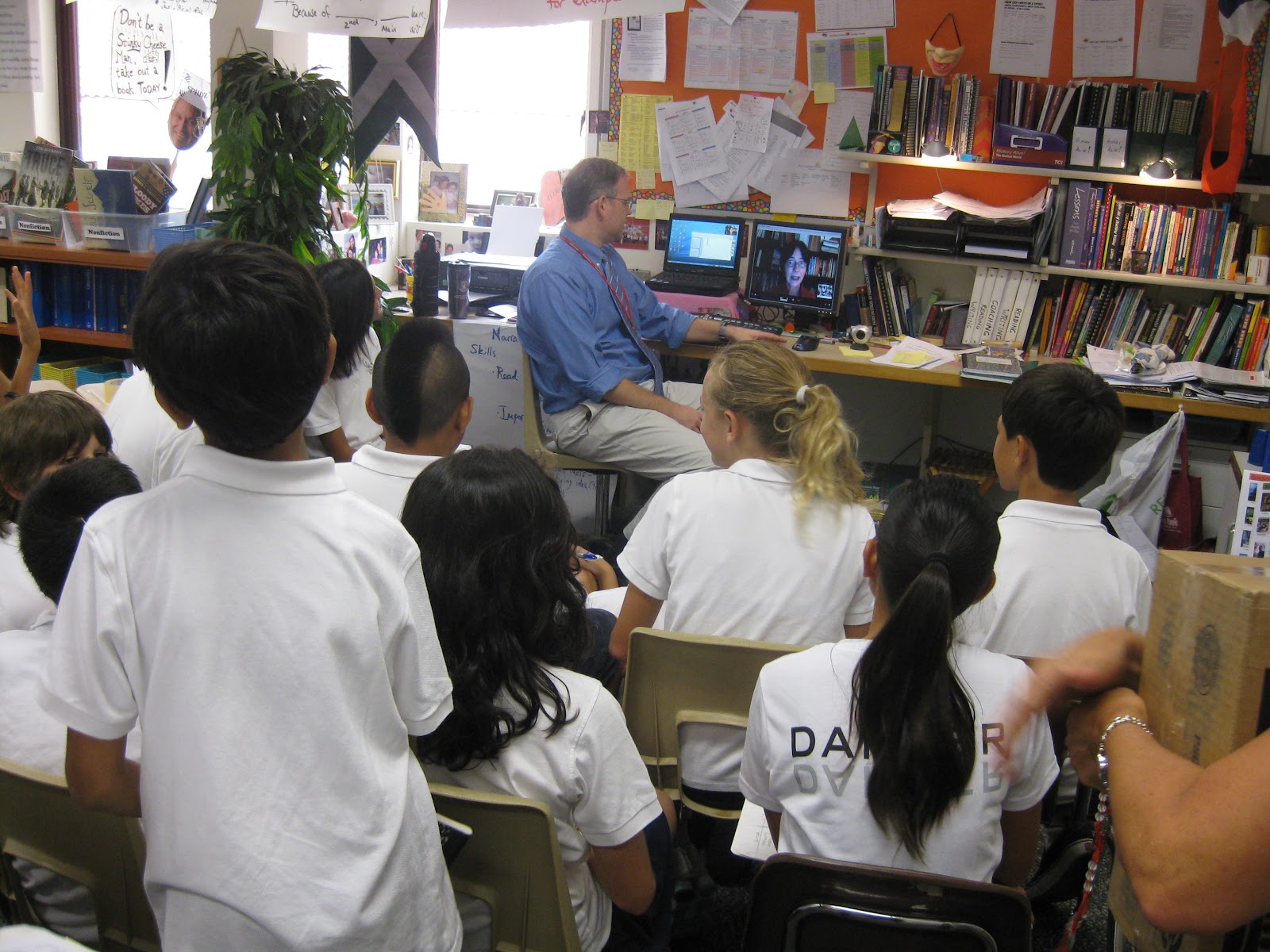
On lucky occasions, email may lead to something else.  Last year, I was fortunate enough to collaborate with Katherine Schlick Noe, author of Something to Hold. In a culminating activity, my classes skyped her and asked her questions about her book and her writing process.  During the interview, they showed her their extension project work as well.  While some authors may not be as willing to communicate with their readers, you'll never know if you don't ask.


Check Out Blogs and Websites


Nowadays, authors are asked to maintain an online presence.  Whether they're blogging about the books they read and schools they visit like Linda Sue Park or writing some brief photo essays like Debbi Wiles, authors are showing their writing in new ways.  

What better way to get to know authors before reading a book club book or read aloud novel than checking out their websites.  They may even have some hidden treasures there.

In this week's Mock Caldecott meeting, Nancy reminded us of this when we talked about Laura Vaccaro Seeger's amazing book Green.

On her website's link for educators/kids, Seeger showed images of her sketchbook and explained how the ideas for this book grew from the very first seeds.  After reading it, I appreciated the book on a whole new level.


Watch Book Trailers and Related Videos

Another exciting possibility is the book trailer,  Based on movie trailers, these short videos are the book talks of the 21st Century.  And with a potent mix of sound, images and video clips, it's no wonder they are a hit with readers of all ages.  It's not surprising that teachers and students are getting into the mix as well by creating their own book trailers.  Check out these Book Trailers of some popular titles:


But good videos about books aren't limited solely to book trailers.  The other day I was visiting Nancy and Brian M.'s class, and they had just shown this video about Iqbal as a final point of reflection after having read the book aloud in class.  


Log on to Goodreads


Many of our Grade 7 and Grade 8 classes are logging on to goodreads.com.  I'm starting to understand why.  After rating twenty books or so, users get recommendations and notifications of new releases that match their profiles.  Not only that, goodreads sends out invitations to participate in author interviews and live chats.

In fact, if you've read The Future of Us or Wonder, there's a live chat with the authors coming up on October 23rd.  Click here to find out more.


These ideas may just be the tip of the iceberg, but my point is this:  there is no doubt that learning about an author can go well beyond that page or two in the back of the book.  As readers, we need to check out what else is out there.  When we do, that other teacher in the room may quite literally come to life before our very eyes.


Images from:  goodreads.com;  buttontrapper.com