Sunday, 2 December 2012

The Coaches Clinic


"Now your bottom hand is the lower jaw of the shark," Coach Oscar yelled to the players as he crouched down and thrust out his left arm.  "The other hand is the upper jaw of the shark.  And when the ball comes towards you, the shark gets hungry."  A player threw a grounder towards Coach Oscar, and he clamped his hands together to grab the ball.  "Is that clear?" Coach Oscar asked.

I looked down the row of players and saw my daughter, Isabelle, and the others nodding.  In minutes, they were all crouching low and snatching up the grounders, and in that moment, the players attending the 2nd-4th Grade Baseball Clinic had become a sea of hungry sharks.

With each skill, Coach Oscar broke it down into a series of moves.   He used metaphors and connections like a hungry shark so that the kids could grasp the concepts more effectively.  He related everything he was doing to what the major league players do, and most importantly, he gave the students lots of time to practice.  

One thing was clear.  The kids were getting it.  In a matter of minutes, they were throwing the ball infinitely better than they had at the beginning.  The key to their success was that Coach Oscar was enabling them to learn by doing.  After showing them (I do), he walked around as they practiced and gave further instructions if needed (We do).  Soon enough, they were all doing it on their own (You do).

As I was watching Isabelle and the other players learn basic skills in throwing, fielding and batting in their Baseball Clinic, I couldn't help but think, where was this coach when I was a kid.  After all these years, I was finally learning how to throw a baseball.  I was also thinking that what I was watching was a form of a Reading and Writing Workshop.  

The idea of the workshop as a clinic isn't a new one.  In fact, just the other week, Sara Holbrook and Michael Salinger, our recent resident poets in 8th grade, referred to their workshops in the classroom as clinics, and now I was realizing exactly why they use that term.

The metaphor of a clinic shouldn't just stop there though.  If our time in the classroom is like a Reading and Writing Clinic for our students, our PLC work together is the Coaches Clinic.  This is when we share our own moves as professionals.  It gives us time to map out essential skills of a unit and plan how we can best assess them.  It gives us a chance to "watch the tapes" of our players after the fact and see what worked and what didn't. And it gives us the opportunity

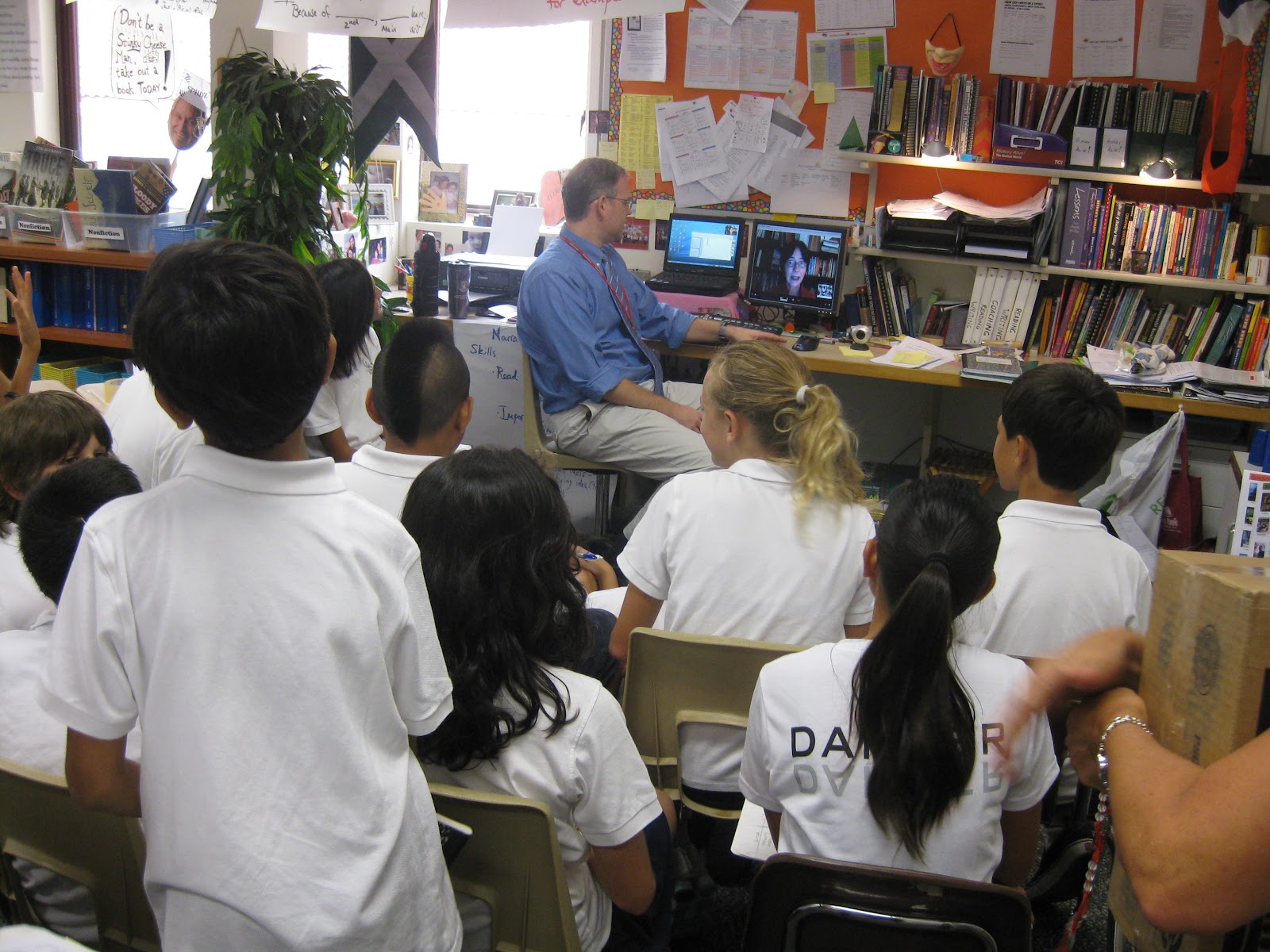
Over Thanksgiving, a group of 25 SAS teachers and I headed to Siem Reap, Cambodia, to conduct our own Coaches' Clinics with our Cambodian counterparts from the Caring for Cambodia schools.  The focus for this year's teacher training trip was science (thank goodness for Jemma H. as I was literally and figuratively out of my element).  For two days, we met teams of teachers to discuss the content, try out some experiments, and explore effective teaching strategies. 

We used the same methods for effective teaching  (I do/We do/You do) that Coach Oscar used in his clinic, and by the third day, the teachers were ready to try the lessons out in their classrooms.  

As we traveled to the five schools on that day, we were amazed at how quickly the teachers had picked up some key concepts such as having students work in groups and letting them do the experiment.  And instead of the teachers always giving the answers, they asked questions and elicited responses from the students.  All this with classes of 50 plus students.

When we arrived at the last school, we noticed right away that the teacher had taken our experiment of mixing water with different solids and liquids and made it better.  Instead of having each group mix all of the substances with water, she had the groups do one each and then compare results across the class.  What did was exactly what we do in our work.  We learn from each other by taking good practices and techniques and making them in our own in the classroom.  

As I get ready for another week in the classroom and look forward to another Coaches Clinic with my PLC, I'm reminded of the following essentials:
  • Teach effectively by breaking the skills down into manageable steps, connecting new learning to prior knowledge or frameworks (the hungry shark), and aIlowing for lots of practice (I do/You do/We do) and timely feedback.
  • View PLCs as a time for me to learn.  I can pick up tips and strategies from my colleagues, and I can gain greater insight from our collective experiences.
  • Know my students as best as I can so that I can help them individually and ensure successful lessons for the entire class as a whole.


Sunday, 18 November 2012

Notes from an Engineering Poet

Michael Salinger and Sara Holbrook

There's been a bit of a buzz in the 8th grade RLA rooms lately.  The culprits who are causing this buzz are none other than  Michael Salinger and Sara Holbrook, poets working alongside teachers and students during their three week extended authors-in-residence visit.

Last week, the RLA 8 team sat down with poets outside of their busy schedule to discuss poetry in the Middle School.  One of the added benefits of a visit like this (apart from the embedded professional development of watching them in action in the classroom) is the chance to discuss how their work as authors may inform our work as teachers.  But when the teachers asked Michael and Sara what they should be thinking of as they revise their poetry unit, they were surprised at the answer they got.

Instead of lists of essential teaching points and resources, Michael simply said, "Listen, before you think at all about lessons, you need to know why you want to teach poetry.  So tell me, why teach poetry?"

The teachers looked around. "Poetry gives students an opportunity to be better observers," they said.

"Okay," Michael continued.  "Why do you want them to be better observers?"

The teachers looked at each other once again.  "Well, in any job, students will have to observe and use good word choice," they replied.

"And why is that important?" Michael insisted.  

"This experience will certainly help them become better communicators," they said.

"And..." Michael led them on.

"And better communication makes people more empathetic," the teachers added.

"So why is that important to you?" Michael asked once again.

"Because," they said with more conviction, "being empathetic makes for a better world community member."

"So," Michael concluded, "you're teaching poetry to help create empathetic and effective communicators who are integral members of a respectful world community.  And so everything you teach in that unit should help support this goal."


Sara Holbrook working her magic with Grade 8.
What Michael did with those teachers was a technique he picked up from his days as an engineer.  In his own words, Michael told me:

"The Five Why is a problem solving technique developed by the Toyota Motor Company and one I used back when I was a quality engineer. It is a questioning process aimed at finding the root cause of a problem. The point of the exercise is to fix the process in which a failure has occurred not to fix the blame.

The activity is also useful in drilling down to a core principle behind our actions in the classroom. It is a technique familiar to anyone who has raised a toddler - why, why,why, why, why? We start with our primary question of WHY followed by four more iterations of the query - each centered upon the previous reply. Now, number crunching statisticians with much more mathematical proclivity than I have determined that it takes five of these cycles to get to the root cause of a problem or action."

This protocol is a great tool for us when revising our unit plans, especially when we need to clarify what we're doing.  Sure, we rely on our shared professional development from recent years and align our work to the newly articulated Common Core Standards to work towards our institutional commitments of creating a common, viable curriculum and gathering evidence of learning and performance, but sometimes we are so focused on the trees, we forget to see the forest.   Why not start each unit planning session defining our principles of the unit with the Five Why method?  


After talking with Michael this week, I thought I'd try it out.  Instead of using it with teachers though, I wanted to see what my students would say about an activity we were doing.  We just finished our read aloud, Freak the Mighty, and we spent a couple of days watching the movie so we could debate which is better, the book or the movie.

I wanted to see what they thought the reasons for us watching the movie were.  Here's what they came up as answers to the Five Whys:
        • Why are we watching the movie?
          • To see which is better.
        • Why do we want to see which is better?
          • So we can have a debate.
        • Why do we want to have a debate?
          • So we can practice speaking and listening.
        • Why do we want to practice speaking and listening?
          • So when we have to do it in the real world, we're better at it.
        • Why do we want to be better speakers and listeners in the real world?
          • So we can make more of a difference in the world.
Students battling it out using their best debate skills.
Right then, we all stopped and looked around.  In that single moment, it was as if watching this movie meant the world to us.  We all shifted in our seats and sat up a little straighter.  We had made a connection that unfortunately, we don't make often enough.  The work that we were doing wasn't to help get prepared for a quiz or a test.  It wasn't to help "get ready" for the next grade level.  What we were working on was going to help us in life. 

Not only should we be asking ourselves the Five Whys, we should be asking our students them too.  For us teachers, we often seek outside affirmation before looking within.  For our students, we don't allow them to dig deep on why they are learning what they are learning.  What Michael reminded us is that the answers to the Five Whys lie within each and every one of us. And when we can all say why we're spending the time on the learning experiences in our classrooms that we are, I have no doubt that we'll be able to answer to a third institutional commitment, great teaching in every classroom, every day for every child.


Images from:
  • http://michaelsalinger.blogspot.sg/p/partner-in-rhyme-sara-holbrook.html
  • http://upload.wikimedia.org/wikipedia/en/7/7d/FreakTheMightyBookCover.jpg

Sunday, 11 November 2012

Without Any Hiccups At All

Imagine my surprise the other night at the dinner table when Isabelle told me she wrote a Personal Essay in class.  "Really?" I asked, looking up from my plate.  Of course as a parent I was interested in what my 4th grader was working on as a writer, but as a teacher, I was also keen to hear what was happening in the elementary grades, especially since our grade level is currently working through the same unit.


"Yeah," Isabelle went on to say.  "My essay is on hiccups.  You see, I got the hiccups in class, and I was so annoyed, I just had to write about it."  I smiled and nodded my head.  I knew exactly what she meant. "So I used 'boxes and bullets' to organize my thoughts, and I came up with three reasons why hiccups are so annoying."  I looked back down at my plate.  That's the exact same lesson I taught to my 6th graders just days before.

As teachers, our initial reaction to situations like this is "How could they do that?" or "Don't they know that's our lesson?"  I admit it, I felt those reactions bubble up immediately.  It's as if we teachers stake claims to lessons and ideas, and we don't want anyone else to encroach upon our territory.  In this case, how could 4th grade be doing our business of boxes and bullets?


Before we all go berserk, I've come to realize that a "problem" like this is actually a good thing.  Here's why.  Isn't it good that readers and writers are being taught effective skills and frameworks as soon as they begin studying the genre?  In fact, their eventual prior learning  will allow us to push them even further when they do get to our classrooms.  

Not only that, just because a student learns some of these skills and frameworks, by no means is she an expert at applying them fully.  You could argue that continued application of  the skill will ensure mastery over a longer period of time.  That's one of the major benefits of a cyclical curriculum anyways.  And as far as studying a genre again and again is concerned, no way does a writer become an expert just by writing a piece in that genre once, twice or even five times.  Authors spend their lives writing through a single genre, and they still find new twists and turns along the way. 

Another consideration is that with our transient student population, invariably there will be new students who are unfamiliar with workshop and some of these skills and frameworks.  And for all students, new to SAS or not, they continue to use the genres and skills that are dear to them to make meaning of new experiences as they grow older.

Having said all that, it's clear the days of closing our doors and doing our own thing in our classrooms are gone.  And they should be.  According to the 2009 MetLife Survey of the American Teacher, one reason why US schools rate lower than their developed nation counterparts is because US teachers spend 93% of their time working in isolation. A related study done by McKinsey and Co. in 2010 found that one common characteristic of schools demonstrating continual improvement in student learning is teachers share and work on their practice together by becoming "learners of their own teaching" (see "Building Capacity to Transform Literacy Learning," NCLE).  In addition, Lucy Calkins contends that you can rate the quality of a school by the amount of meaningful conversations that teachers have about moving their students forward.  


Simply put, we must seek every opportunity to step out of our classrooms and grade levels to engage in meaningful conversations with our colleagues.  Now that our school has worked to implement the Reading and Writing Workshops, the initial years of every teacher trying out the generating ideas lessons or basic craft lessons of a genre have passed.  Our readers and writers are coming up with more skills and experience.  It's as if we were all learning to ride bikes at the same time, and now that the training wheels are coming off, those lessons just won't cut it anymore.  It's time to work on jumps, wheelies, and hard core racing.  In other words, maybe 4th grade should cover boxes and bullets whereas 6th grade can focus on ordering the bullets for effect.

So how do we do this?  

  • Instead of thinking how can I teach "my students" in "my classroom,"  think how can we teach "our students" in "our school."
  • Be active members in PLCs by asking questions not only of the units in our grade levels, but of what is happening in the surrounding grade levels.
  • When planning units, use the Common Core as a resource for writing teaching points.  With its more precise articulation at each grade level, we can ensure a steady progression of rigor as our readers and writers pass up through the grades.
  • Use pre-unit assessments to gauge where the students are in terms of the work each genre requires.  Then modify and adjust teaching points accordingly
  • In mini-lessons, continually call on students to apply previously learned skills and frameworks to their current work.
  • Continue to read and write so that we can better inform our teaching.  By actually doing the work of readers and writers, we can teach from true experience and develop teaching points that come from the heart.
And finally,
  • Don't leave it up to a 4th grader to find out what is happening in other classrooms and grade levels.

If we take on just some of these ideas collectively, we'll continue to grow as a school and provide an exemplary program in RLA without any hiccups at all.


Images from:


Monday, 29 October 2012

Preparing for the Storm

New Yorkers scurry through the streets, rushing to the nearest grocery store to stock up on bare essentials.  Weathermen point to technicolor maps portraying doom and gloom.  Officials flood the airwaves with emergency contingency plans.  The entire city is on edge as they prepare for the arrival of a most unwelcome guest, Hurricane Sandy.

As I made my way to Teacher College's Coaching Institute last week, there's no way I could've predicted that this is where I would find myself by Sunday evening.  Today, I'm hunkering down in my hotel room to see if the brick wall outside my window will budge under the blustery conditions.  As I do, I can't help but think that I've felt the same sense of urgency in my sessions with keynote speakers and staff developers about the current storm looming in education.


The Storm is Looming


In her keynote, Lucy Calkins noted that education is at a major crossroads.  With the advent of the Common Core Standards, one of the "most significant documents in the history of American education," educators are poised to make dramatic change.  The problem is, she added citing her work with Hargreaves and Fullan, the authors of Professional Capital, the pathway to implement change is not so clear.  Some leaders advocate a business approach with an emphasis on short term reforms and cost-saving measures while others push for a professional approach that acknowledges the complexity of teaching and relies on the collective capacity of experienced teachers.  At this point, it is unclear which way education will go.  Meanwhile, the storm is looming.

As if this isn't enough, Tony Wagner, author of The Global Achievement Gap and Creating Innovators, stated in his keynote that reformers have it all wrong.  The system of education is not failing, it's completely obsolete.  With the disappearance of routine, semi-skilled jobs and the democratization and commoditization of knowledge, it's time to reinvent how we educate our students.  We need to promote a culture of learning and innovation.  Here's why:


Wagner went on to say how the current culture of school is radically at odds with the culture of learning:

The Culture of Today’s Schooling
The Culture of Learning and Innovation
  • Schools celebrate individual achievements

  • Schools celebrate collaboration and collective achievement

  • Schools honor specialization and becoming specialists (teachers work in departments, students declare majors)

  • Schools promote approaching problems from multiple perspectives and disciplines

  • Schools impose a culture of passive consumption where students are meant to take in and regurgitate

  • Schools seeks ways in which students can create real products for real audiences

  • Schools penalize failure

  • Schools honor risk taking and learning from failure

  • Schools rely on external motivation

  • Schools rely on intrinsic motivation


Clearly, the storm is looming, and it can leave us in a frenzied state wondering how we can prepare ourselves to make a difference.  Just like the people who loaded their baskets with food, water, and flashlights ahead of Hurricane Sandy, we need to take action.  


Preparing for the Storm

So what's in our basket?  The good news is, we already have many practices, routines and frameworks in place as we move forward.  In addition, I offer up these reminders and considerations as we continue to fine-tune our work in and out of the classrooms.


Student Checklist for Opinion Writing
1.  We need to continue to teach with intensity and purpose in our Reading and Writing Workshops.  As I observed staff developers in classrooms on Friday, I noticed how they implement mini-lessons that encourage more student reflection and action.  By continually referring to checklists, writing more "flash drafts," and monitoring their progress throughout a unit, students work actively as they transfer skills across units, increase their volume and develop independent writing habits. 

2.  We need to continue to work collaboratively with our colleagues.  As Literacy Coaches Gina La Porta Roller and David Lowe noted through their work with teachers in Seattle schools, we can pinpoint effective practice, promote areas of inquiry, and calibrate student learning and teacher practice within and across grade levels thereby leveraging our collective capacity.  This is perfect work that some of us are already tackling in our PLCs.

3.  Throughout our work, we should think about how we can integrate and assess the "Core Competency" skills that Wagner states are essential in creating innovative students.   These include:

  • Critical Thinking/Problem Solving
  • Collaborating
  • Adapting
  • Initiating
  • Effective Oral and Written Communicating
  • Accessing and Analyzing Information
  • Developing Curiosity and Imagination


4.  We need to use our time wisely.  Let's face it, time is our most precious commodity, and how we use it both in and out of the classroom matters.  We need to ensure that our students are spending the bulk of the time in our classrooms by reading and writing.  Staff Developer Chris Lehman noted that it takes two hours of reading a day for a struggling student to make up more than a year and a half of growth over time.  To get better at anything, we need time to practice and rehearse.

In addition, Wagner suggests we should make time for play.  He cited the 20% Google Rule as a model that we can emulate not only for our students, but for us as well.  By allowing for time while holding ourselves accountable for exploration through personal passion, we would model risk taking and continued learning for our students.  Who knows, we may be surprised with what we come up with as well.


So in the face of an oncoming storm, things don't always have to be so dreary.  As I watch Mayor Bloomberg and his team conduct press conferences where they explain the choices have made and the plans they have set in anticipation of Hurricane Sandy, I'm inspired by their forethought and insight in seeing this storm through safely.  I believe that we can do the same for current state where we are in education.  So what do you say, are you with me?


Images from:  
  • www.abcnews.go.com
  • irisconnect.co.uk
  • newyork.cbslocal.com/   

Sunday, 14 October 2012

The Other Teacher in the Room

In one of my recent posts, I mentioned that there are other teachers in the room, and we can use technology to invite them to participate in ways that seemed unimaginable even just a couple of years back.  Of course, these teachers are the students, and they certainly have a  lot to add to every discussion and activity. This week I was reminded of something that I know all too well but forget far too often.  There's yet another teacher in the room, the author.  

Through read alouds, shared texts and independent reading, we sit down with these master storytellers and revel in their work.  We look closely at the choices they make, use them as inspiration, and even try to emulate them in our own writing.  The thing is, with technology these days, the learning does not have to stop with reading their books.  There are countless ways to connect with them.


Email or Skype the Author


Megan, a student of mine, rushed into the classroom during break earlier this week.  "She wrote back!" she beamed.  She was none other than Jennifer Armstrong, author of Shipwreck at the Bottom of the World.  

Just a few days before, Megan handed in her letter to Armstrong as a reading response for my class.  She wasn't too optimistic that she would hear back from her, but she was glad she tried.  She came up with the idea of writing to Armstrong when I showed the class my letter to Goodreads about possible interview questions for Lois Lowry on her new book, Son.  Asked how she got the author's address, Megan answered,  "Simple.  It's online."

But then Armstrong's reply came, and it made all the difference in the world to Megan. In it, Armstrong elaborated on how she came up with the topic and how the publication of her finished product was pure serendipity as it coincided with a nationwide exhibit on Shackleton's trip.  Check out Megan's response to Armstrong's letter:


On lucky occasions, email may lead to something else.  Last year, I was fortunate enough to collaborate with Katherine Schlick Noe, author of Something to Hold. In a culminating activity, my classes skyped her and asked her questions about her book and her writing process.  During the interview, they showed her their extension project work as well.  While some authors may not be as willing to communicate with their readers, you'll never know if you don't ask.


Check Out Blogs and Websites


Nowadays, authors are asked to maintain an online presence.  Whether they're blogging about the books they read and schools they visit like Linda Sue Park or writing some brief photo essays like Debbi Wiles, authors are showing their writing in new ways.  

What better way to get to know authors before reading a book club book or read aloud novel than checking out their websites.  They may even have some hidden treasures there.

In this week's Mock Caldecott meeting, Nancy reminded us of this when we talked about Laura Vaccaro Seeger's amazing book Green.

On her website's link for educators/kids, Seeger showed images of her sketchbook and explained how the ideas for this book grew from the very first seeds.  After reading it, I appreciated the book on a whole new level.


Watch Book Trailers and Related Videos

Another exciting possibility is the book trailer,  Based on movie trailers, these short videos are the book talks of the 21st Century.  And with a potent mix of sound, images and video clips, it's no wonder they are a hit with readers of all ages.  It's not surprising that teachers and students are getting into the mix as well by creating their own book trailers.  Check out these Book Trailers of some popular titles:


But good videos about books aren't limited solely to book trailers.  The other day I was visiting Nancy and Brian M.'s class, and they had just shown this video about Iqbal as a final point of reflection after having read the book aloud in class.  


Log on to Goodreads


Many of our Grade 7 and Grade 8 classes are logging on to goodreads.com.  I'm starting to understand why.  After rating twenty books or so, users get recommendations and notifications of new releases that match their profiles.  Not only that, goodreads sends out invitations to participate in author interviews and live chats.

In fact, if you've read The Future of Us or Wonder, there's a live chat with the authors coming up on October 23rd.  Click here to find out more.


These ideas may just be the tip of the iceberg, but my point is this:  there is no doubt that learning about an author can go well beyond that page or two in the back of the book.  As readers, we need to check out what else is out there.  When we do, that other teacher in the room may quite literally come to life before our very eyes.


Images from:  goodreads.com;  buttontrapper.com


Sunday, 7 October 2012

Making Claims and Providing Evidence

Something amazing happened this week.  Unfortunately, it wasn't a peace deal in Syria, or an end to the global economic down turn.  No, what happened was that Big Bird may have finally been put on notice.

If you weren't one of the 70 million plus viewers or a contributor to the 10.3 million tweets, you may have missed the US Presidential Debate on Wednesday night.  Regardless of political affiliations, many analysts, pundits, and viewers alike attribute Romney with winning the debate.  He "emerged from the fog" as David Brooks wrote.   And while some reported that the debate lacked a bit of luster, I was blown away, not necessarily at what the candidates said, but on how people reacted.


At one point during the debate, Romney said, "I'm going to stop the subsidy to PBS.  I'm going to stop other things.  I like PBS.  I love Big Bird.  I actually like you, too (Jim Lehrer).  But I'm not going to--I'm not going to keep on spending money on things to borrow money from China to pay for."

Instantly a flood of reactions hit the twittersphere peaking at 140,000 tweets per minute.  The next day, the CEO of PBS was interviewed on Nightly News, and since then even young viewers voiced their opinions.  Not all reactions were negative though.  Ari Fleischer tweeted, "Big Bird needs to ask Dora the Explorer how she manages 2live without tax payer money.  Try it Big Bird.  You'll be just fine."  Unfortunately for Romney, he just can't get his claims to come out right.  Remember the 47%?  And this time, his claim on stopping spending got lost in a cloud of yellow feathers.         
                
My point is, we're reacting to claims more than ever before. As soundbite scavengers, we look for simple take-aways that make lasting impressions.  For better or worse, political campaigns are built on this, and so too is our 24 hour news cycle society.  Claims are captured, replayed, and double-checked more than ever before.  It seems like the term "fact check" appears in the news daily now, and there's even an organization dedicated to it, factcheck.org.


It's no wonder then that the Common Core emphasizes the teaching of making strong claims and supporting them with valid evidence so much. 

The words "claim" and "evidence" only appear a couple of times in the Common Core, but  if you look across the standards in reading and writing, it's everywhere really.  In the following charts, I pulled the standards for Grade 6 and turned them into claims that I want my students to be able to make or do.  For each claim, there is accompanying evidence that students need show or use to support their claims.


I may have gone claim crazy, but I used this framework when I had my students set goals for reading and writing.  I told them that a goal is just a claim that you want to be able to make in the future.  The steps to achieve the goal, I told them, will become the evidence you accumulate along the way to prove that you achieved the goal.

In today's world, we can't avoid making claims nor should we.  Being part of a democratic society depends on it too much.  What we should do is teach to it more directly.  Students need to state strong claims and provide supporting evidence often.  They need to notice when others state claims and ask whether the evidence is valid or not.  In doing so, they'll become more effective communicators and critical members of society.  That's my claim, now prove me wrong.


Images from:  
http://www.huffingtonpost.com/2012/10/04/mitt-romney-big-bird_n_1940400.html?utm_hp_ref=mostpopular
http://factcheck.org/